
By: Melody Stacia
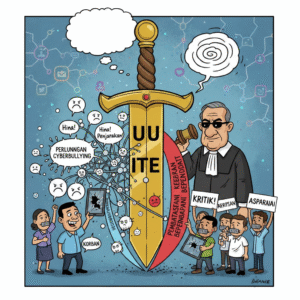
Behind the convenience and freedom it offers, social media can also become a space where words are misused as weapons.
Social media has become part of everyday life, especially for youths. It is a place to share thoughts, express opinions, and stay connected with others. However, behind the convenience and freedom it offers, social media can also become a space where words are misused. Bullying on social media, often referred to as cyberbullying, is a skyrocketing issue that can seriously affect a person’s mental health and reputation. Furthermore, in Indonesia, this problem is not only a social concern but also a legal one, hence it is regulated under the Undang-Undang Informasi dan Transaksi Elektronik (UU ITE).
Cyberbullying occurs when someone uses online platforms to insult, threaten, humiliate, or spread harmful information about another person. Unlike bullying in the real world, cyberbullying does not end when people log off. A single comment can be shared repeatedly, reaching audiences far beyond its original context. Because digital content is difficult to erase completely, the impact of cyberbullying can last for a long time.
For victims, these attacks can feel overwhelming, as if their mistakes or weaknesses are permanently displayed in public.One common form of cyberbullying is pencemaran nama baik, or defamation. This happens whenfalse statements or insulting content damage someone’s reputation. In Indonesia, defamation on social media is regulated by Law Number 11 of 2008 concerning Information and Electronic Transactions, which was later amended by Law Number 19 of 2016. The most relevant provision related to this issue is Article 27 Paragraph (3) of the UU ITE. This article states that anyone who intentionally distributes or transmits electronic information containing insults or defamation can be punished under the law.
The penalties under this article are serious. A person found guilty may face up to four years of imprisonment and/or a fine of up to 750 million rupiah. This shows that online behaviour is treated as real behaviour with real consequences. The law aims to remind social media users that freedom of expression should not come at the cost of another person’s dignity. Writing something online may feel casual, but once it is published, it can no longer be fully controlled.
An example of a cyberbullying and defamation case could involve someone posting accusations without evidence. For instance, if a student uploads a post claiming that a classmate cheated or behaved improperly, and the claim is untrue, the victim’s reputation may be harmed.Even if the post is later deleted, screenshots and reposts may continue to circulate. In such situations, the victim has the right to report the incident, and the person who posted the content could face legal action under Article 27 Paragraph (3) of the UU ITE. Several real cases in Indonesia show that people have been investigated or charged for online posts they initially believed were harmless.
Despite its importance, the UU ITE is often debated. Some argue that the law can limit freedom of speech because its interpretation may be too broad. This makes it a double-edged sword: it protects individuals from online abuse while also raising concerns about free expression. However, its main goal remains to prevent social media from becoming a place where insults and false accusations are made without consequences.
Responsible communication online is not only a sign of maturity but also a legal responsibility.
Thus, bullying on social media is not a small issue that should be ignored. Words shared online can cause real harm and leave long-lasting effects. Through the UU ITE, Indonesia recognises that digital spaces must be used responsibly. For students and young people, this serves as an important reminder to think carefully before posting. In the end, responsible communication online is not only a sign of maturity but also a legal responsibility.
